
Adrienne Rich (1929 - 2012)
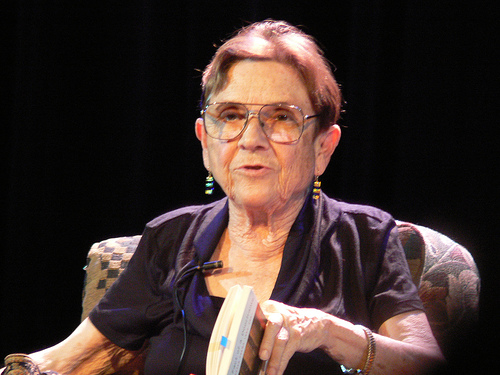
Adrienne Rich’s contribution goes well beyond the field of poetry. That is something that she must be truly proud of, no matter how insufficient she may consider it. Indeed, the world is in need of a great deal more radical socioeconomic politics, and that is why this small (in size) and fragile-looking (at eighty) woman is right in her ceaseless denunciation of injustice. This is not to say that as a poet she is anything but great, especially these days, but rather that it is truly impossible to overlook the practical, real-world impact of her writings and militancy.
In a “Poetry and Politics” Conference at the University of Stirling (2006) I enjoyed the opportunity to attend her keynote speech. She expressed with impressive energy and eloquence her strong belief that “poetry is above all not some kind of aromatherapy,” paraphrasing her own line from “Legislators of the World”: “Poetry is not a kind of linguistic aromatherapy.” It is easy to interpret this line: Regardless of the thousands of mediocre poems of bland sentimentality written every day at innumerable workshops and countless community colleges, poetry, or rather POETRY, plays a role in our lives, and bears enormous responsibility toward humankind. Rich condemned the assumption that poetry exists in order to exorcise our boredom, inferiority complexes, need to feel creative, and similarly selfish goals. By rescuing a now famous quotation from Shelley’s “Defence of Poetry” (“Poets and philosophers are the unacknowledged legislators of the world”) she was reminding poets and poetry readers of the power of words to operate real changes in real life, and of the moral responsibility that comes with such power. In other words, a poet cannot turn his back on human grief and lock himself in his ivory tower to write parables and allegories about suffering while real people are experiencing it not far away.
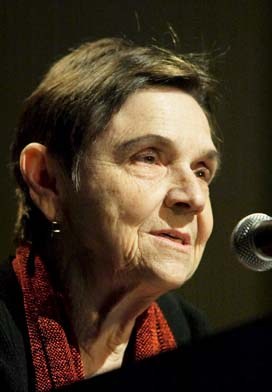
Born in Baltimore in 1929, Adrienne Rich grew trying to live up to the strict intellectual standards of her father. She developed a not atypical relationship with him based on balancing the need to obtain his approval with an understandable unspoken rebellion. Like many other budding figures of those days, she caught the public eye, and ear, when W.H. Auden gave her 1951 collection A Change of World a Yale Younger Poets Prize. While Auden’s review was in tune with his landmark paternalism toward women poets, it was nonetheless right on the mark, for Rich’s early poetry was indeed a cool formalist feat devoid of much emotional involvement. She had become the worthy heiress of a male poetic tradition that had little or no room for women poets—and in fact similar accusations have been made of other successful women poets such as Marianne Moore and Elizabeth Bishop, to name but two. Little did they know then—perhaps even less Rich than anyone—that she would live to write some of the most passionate and incendiary verse of the century.
While working for the SEEK program in New York, she became involved in civil rights and social justice movements, developing a growing awareness of the relationship between language and gender, sexuality, and power. In her case, this led to eventual repudiation of a male-dominated culture where women were oppressed figures in the need to find their own voices. Her project was in many ways the attempt to return the speech ability to those who had been deprived of it, especially women. Her new poetry of the late 60s and 70s addresses from within a rich cultural (socio-anthropological) framework the freedom to choose new sexual roles, the rights of lesbians, and the healing of any form of social injustice. After rejecting the National Medal for the Arts she wrote a passionate justification. This is part of that document:
Anyone familiar with my work from the early Sixties on knows that I believe in art’s social presence—as breaker of official silences, as voice for those whose voices are disregarded, and as a human birthright. In my lifetime I have seen the space for the arts opened by movements for social justice, the power of art to break despair. Over the past two decades I have witnessed the increasingly brutal impact of racial and economic injustice in our country.
There is no simple formula for the relationship of art to justice. But I do know that art—in my own case the art of poetry—means nothing if it simply decorates the dinner table of power which holds it hostage. The radical disparities of wealth and power in America are widening at a devastating rate. A President cannot meaningfully honor certain token artists while the people at large are so dishonored.
Ernesto Suárez -Toste (Universidad Castilla La Mancha)
Autor:Ernesto Suárez Toste (Universidad de Castilla la Mancha)
MLA
APA
Chicago